i wove in my senses so you can play wıth them (WIP, 2026)
Interactive E-textile Installation
Advisor: Nathalie Gebert
Conceptual Framework
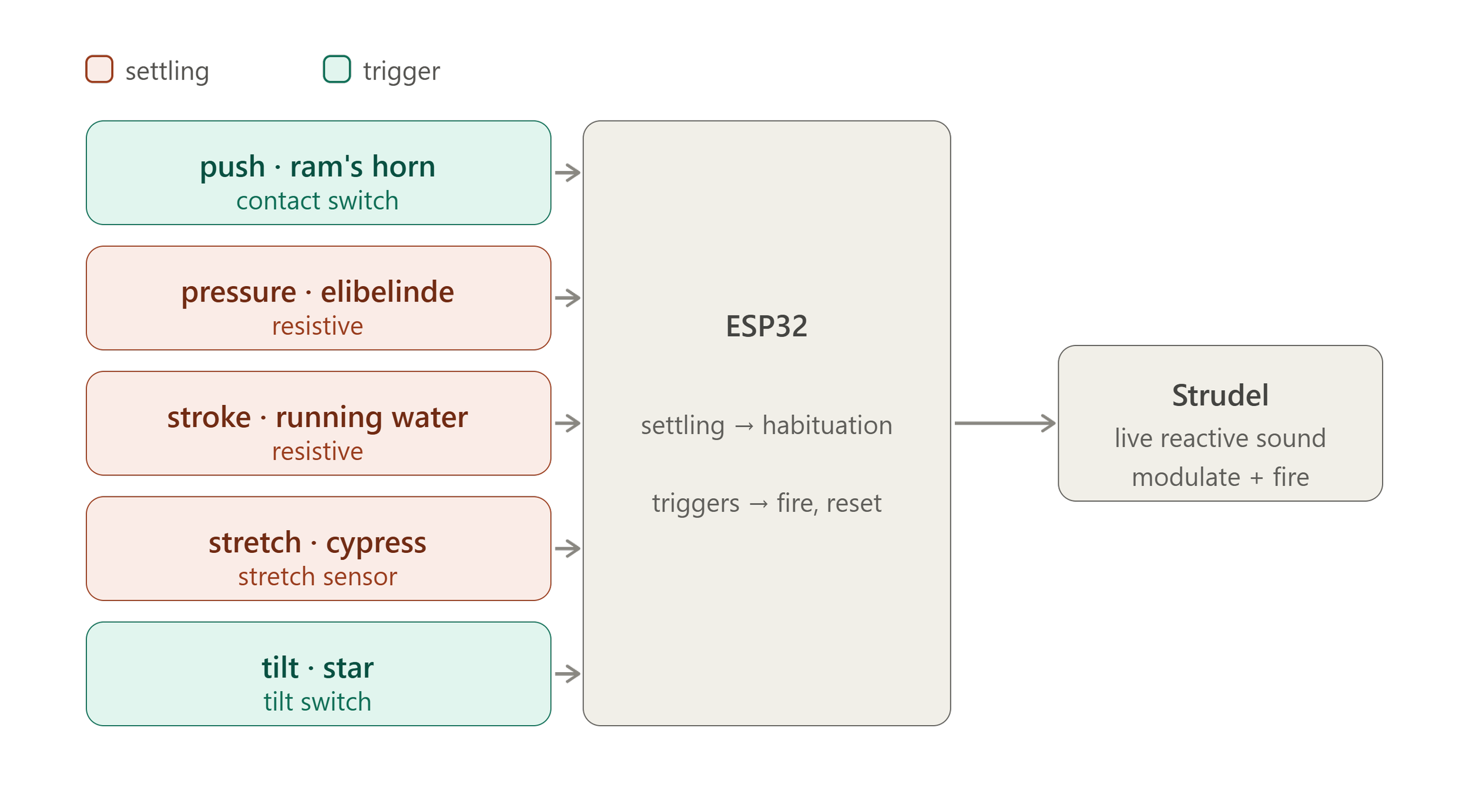
The textile responds to touch in two modes. Settling regions habituate: under sustained contact their signal adapts and returns to a baseline, following the same principle by which sensory receptors stop reporting a constant stimulus. Trigger regions fire once on a discrete action, such as a press or a tilt, then reset. Visitor contact is translated into sound and light in real time, so the surface registers new contact and lets sustained contact fade, a working model of how habituation operates in perception.
Motif and sensor are matched so that meaning corresponds to gesture: the ram's horn (power) is activated by a push; the hands-on-hips elibelinde (mother-goddess) by a sustained press; running water (flow) by a stroke; the cypress (tree of life) by a stretch; the star (fortune) by a tilt. The nazar, or protective eye, is distributed across the field as an accent rather than a sensor.
From Motif to System
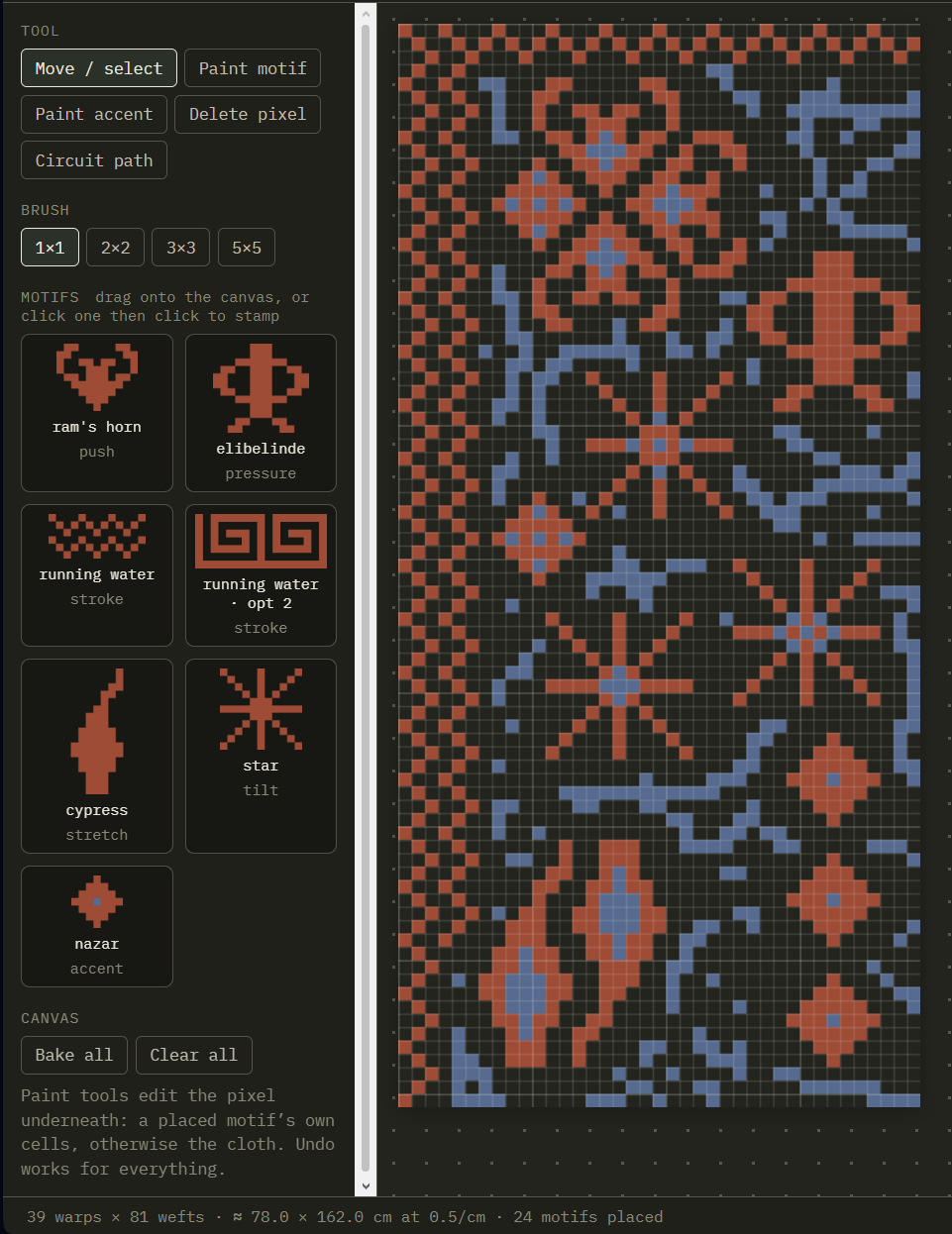
Development began by matching the motif vocabulary to a set of textile sensors, then designing the weave. A custom weaving-canvas tool was vibe-coded for this stage: motifs are drawn cell by cell on the actual sett, arranged across the field, and overlaid with the path the conductive thread will follow, so the weaving chart also serves as the circuit map. A second, browser-based tool converts the live sensor data into sound, keeping input and output in a single runtime without external software.
I wove in my senses so you can play with them is a hand-woven, touch-sensitive textile that adapts the visual language of the Anatolian carpet into an interface read by touch. The work evokes a kilim without imitating one, taking the loom as its starting point: a site of women's craft, income, and independence, and a system in which motifs carry meaning. Each motif is also a sensor, matched so that the gesture that activates it corresponds to the meaning the symbol traditionally holds.
The project treats weaving as an early algorithm. A woven cloth is a sequence of binary decisions, weft passing over or under warp, carried out by hand long before mechanical looms automated it. On this basis each motif is triple-coded: a traditional sign, a woven structure, and a circuit at once, since the conductive thread is couched directly along the motif's lines.
Technical Approach
A single ESP32 reads the woven sensors and transmits the gesture data over its own network.
Conductive stainless-steel thread is couched along each motif's lines, so the decorative line and the conductive path are the same stitch.
Sensor types span capacitive touch, resistive pressure and stretch, and contact and tilt triggers, one per motif region.
Settling regions run an adaptive-baseline (habituation) model; trigger regions fire and reset.
Gesture data drives sound and light in real time through a custom browser tool rather than external show software.
Currently in development for its first exhibition, Textile & Algorithm, HfK Bremen, November 2026.